
Charlotte’s Story: In honor of Domestic Violence Awareness Month.

Pexels
*full names have been omitted for safety purposes
Charlotte’s black, swollen eye made it difficult for her to see when she ran for her life toward the Speedway gas station in Pine County, Minnesota on November 25, 2020. She was able to break free from the handle on the dashboard where her wrists were bound by zip ties. She had a blistering red rash on her neck from the seatbelt that was used to strangle her, and a bullet hole in her left snow boot.
Just an hour earlier, Charlotte’s boyfriend forced her to write a suicide note to her family with a gun pointed at her leg. He had accused Charlotte of flirting with his brother earlier in the day. She denied it and tried to calm him down, but his anger was never easily soothed. He shot at her foot to scare her; somehow the bullet barely grazed her skin.
Their relationship was only four months old. The abuse began rather quickly and occurred about every ten days. But each time it was followed by a heart-wrenching apology, pulling Charlotte back in.
She made it to the convenience store’s entrance, her face stricken with panic. Since the gas station was surrounded by nearby woods and a freeway, she figured running toward the store full of witnesses was her best bet at receiving help. Startled to see she escaped, Charlotte’s 200-pound boyfriend rushed toward her from inside the store, throwing her onto the wet concrete with a force stronger than the Minnesota winds that Thanksgiving night.
He grabbed her by her long brown hair and dragged her back to his Jeep Renegade. He opened the back driver’s side door while Charlotte fought back. Her resistance worked — she did not make it inside the vehicle. Only a part of the jacket she was wearing made it through the door before he slammed it shut. And then away he drove, with her clinging to the side of the door.
Witnesses from the gas station followed in their car while on the phone with a 9-1-1 operator.
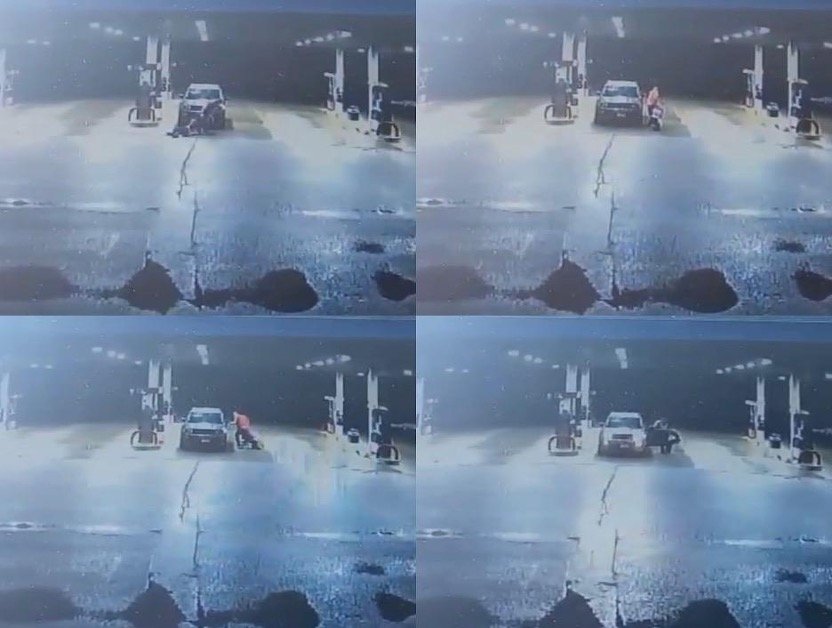
Screenshots of surveillance camera capturing Charlotte being dragged to vehicle.That same year in 2020, according to the United Nations Office of Drugs and Crime (UNODC), around 47,000 women and girls worldwide were killed by their intimate partners or family members. This means that on average, a woman is killed by someone in her own family every 11 minutes. The UNODC labeled home as “the most dangerous place for women.”
“Domestic violence is like no other crime,” writes journalist and author Rachel Louise Snyder in her book No Visible Bruises: What We Don’t Know About Domestic Violence Can Kill Us. “It does not happen in a vacuum. It does not happen because someone is in the wrong place at the wrong time. It’s violence from someone you know, from someone who claims to love you.”
Many of the laws around domestic violence in the United States are fairly recent. A century ago, “wife beating” was legal—except between the hours of 10 p.m. and 7 a.m., when the noise might keep the neighbors awake. Seen as merely a private family matter in the eyes of the law, it wasn’t until 1984 that Congress passed the Family Violence Prevention and Services Act, which helped fund shelters and other resources for victims. A national hotline for domestic abuse victims was not established in America until 1996, and stalking—a leading contributor in domestic violence homicide cases—was not classified as a crime until the early 1990s.
There are over a dozen countries, including Egypt, Haiti, and the Congo, where domestic violence is legal today.
“The American Society Against the Cruelty of Animals predates laws against cruelty towards one’s wife by several decades,” writes Snyder, “meaning, I suppose, that we held our dogs in higher regard than we held our wives.”
For one mile, Charlotte’s small frame clung to the side of the Jeep. Her wrists were still bound together, as she tried her best to hold on to the side of the car door. He was driving so fast, she looked like a flag flying in the air. Every few seconds, her dangling legs would hit the pavement. She tried to spin her body so the road wasn’t hitting the same part of her leg. But eventually her body gave out; she hung limply from the side of the car.
He stopped the Jeep abruptly and got out— his dark, sunken eyes stared at her. Veins bulged from under his neck tattoo that reads “trust no bitch.” Yet, he seemed uncharacteristically calm; the look on his face let Charlotte know that he was on a mission.
“Are you done yet?” he asked. Taking her lack of response as an answer, he got back in the car and continued to drive for another mile until slamming on his brakes, shattering her ribs from when she hit the concrete below. He threw her limp body into the passenger’s seat and continued to drive toward a wooded area near a river.
Charlotte slowly started to wake up as drove onto a tall metal bridge toward nearby railroad tracks. Fearing he was taking her to the isolated woods nearby to end her life, she leaned over and grabbed his steering wheel, pulling as hard as her bound wrists allowed, prompting his loaded gun to fall off his lap and his Jeep to crash.
He emerged from the wreck and dragged her limp body through a nearby construction area. The sound of sirens wailed through the air. A line of small cozy homes could be seen in the distance. Worried that the police would find them, and hopeful Charlotte would succumb to her injuries, he placed her in a nearby shed behind a rusted sheet of metal, where she passed out again.
“I wasn’t surprised that [he] did that to her,” said Val, his estranged wife. “I told her that he was going to hurt her. I tried to warn her. I even contacted her to tell her she was making a big mistake.”
Val married this man on October 10, 2018. According to Val, her then-husband “busted” her lip in the very first month of dating. The similarities between Charlotte and Val’s stories are eerie. “He was telling me how he’s got to shoot me to teach me a lesson, but if I act right, he will only shoot me in the foot,” Val said. He threatened to light her friend’s house on fire where she lived, and encouraged her to write a letter to her children to tell them goodbye “because I was never coming home.”
“He doesn’t try to hide his abuse at all. He doesn’t care who witnesses and feels zero remorse afterward,” Val said.
When they were together, his abuse ranged from punches to her face, vandalism of her property, locking her in the bedroom for hours, death threats, choking, cutting her hair, and stabbing. “He told me he was going to shoot me up with Fentanyl and kill me,” Val said.
She finally decided to leave the relationship in April of 2020. She moved out of the home they shared– and with only the clothes on her back– stayed at a hotel with “literally nothing.”
He was dating Charlotte by August 2020.
Although there are resources to help victims of domestic abuse, many, like Charlotte and Val, end up hiding in hotels. “I didn’t go to a shelter because I had money and felt that the shelters should be saved for victims who literally have no place to go,” Val said. “Plus, I don’t think I was ready to be labeled as a victim of abuse. It’s hard to go to shelters because of the stigma attached. But when I ran out of money, I went to a shelter for a week. And when you finally go to a shelter, it’s a reality that you finally have to face—that your husband is an abuser and you are a victim. And I don’t like to be a victim”
Domestic violence is a very confusing time, according to Ashely Rumschlag, CEO and president of DomesticShelters.Org, a popular online organization that provides resources for victims. Having an advocate to help survivors understand what they are going through and what resources are available is critical. “Leaving is the most dangerous time for a survivor,” said Rumschlag, “and having a safe place to go to can be a matter of life or death.”
A 2021 report by the National Network to End Domestic Violence reveals that due to the pandemic, many programs were forced to redirect already-limited funding to expenses like technology improvements and hotel stays to protect the health of staff and survivors. In addition, grants decreased as much as 70 percent, resulting in the loss of billions of dollars that supported over 6,000 organizations. Because of this, per the report, over 9,444 domestic violence survivors were met with denied requests, like emergency housing.
DomesticShelters.org asked 366 participants in a survey, “if you’ve been turned away from a DV shelter because of lack of space, what did you do?” Almost half of the participants, 158 total, returned to their abuser.
“With domestic violence, often there is no end date for the victims,” writes Snyder in her book. “Even if children are not involved, many victims remain on the lookout long after they escape abuse– particularly if incarceration was a result of the abuse.”
Although the pandemic led to a lack of resources and unmet needs for victims, the same report by the National Network to End Domestic Violence indicates that 38,608 adult and child victims of domestic violence found refuge in emergency shelters, transitional housing, hotels, or other housing provided by local domestic violence programs in 2021.
“Bottom line: staying in an abusive situation is never the best option,” writes Domesticshelters.org on their website, “Even if you don’t have a place to go, there are agencies, nonprofits, and shelters that can and will help you. Start by contacting a domestic violence advocate in your area and ask about the resources available in your state.”
It was 3:30 in the morning when a plump elderly woman playing a video game on her computer was startled by a knock at the door. It was Charlotte. She had awoken in the shed – alone and cold – and wandered to a nearby house to ask for help. Her right eye was swollen shut, and chunks of her hair had been ripped out. She had dirt and blood all over her battered body. Her wrists were still bound with zip ties. She was shivering and hardly able to speak.
“I need help. Someone is trying to kill me,” Charlotte said through trembling breaths. “Can I use your bathroom?”
The gray-haired woman compassionately obliged and directed her to the toilet, where Charlotte slipped into unconsciousness again. She woke up shortly after in a blurred haze, while the woman bolstered her off the toilet and helped her pull up her pants.
“It’s over now,” she said, “you’re safe.”
She held Charlotte in a warm, pillowy hug. “Now let’s get you help, the ambulance is on the way.”
At the hospital, Charlotte was treated for bruising on her brain from the blunt force trauma, gashes on her wrists (and the nerve damage to her fingers she still experiences today), two sprained wrists, road rash on her legs, cracked ribs, and a sprained neck. The next day, detectives went to her hospital room to take a statement, a Ziplock bag-in-hand containing locks of her hair from the gas station parking lot.
It gets worse.
After her hospital stay, her mom drove her back to her house. All that remained were charred and burnt fragments of what used to be her vehicle and home. Charlotte’s boyfriend had set everything on fire—including a storage container holding all of her deceased father’s belongings.
One week later, when Charlotte’s eye was just starting to open back up from the swelling, he found her at a motel where she was hiding with her daughter.
She went back to him.
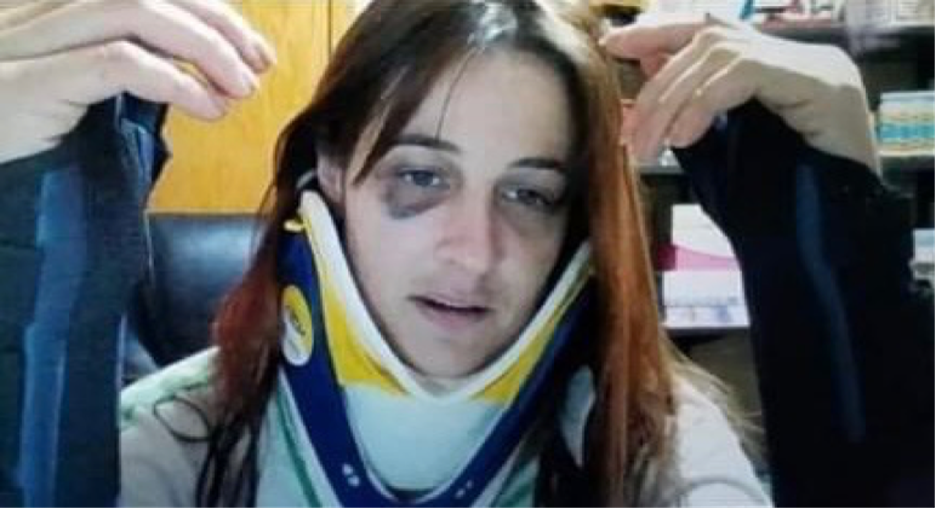
Charlotte after her hospital stay. People who haven’t experienced abuse often struggle to understand why others remain in abusive relationships. Survivors of domestic abuse usually end up remaining in a relationship with their abuser. One reason is because of an emotional attachment called “trauma bonds.” The term “trauma bond” was coined in 1997 by Dr. Patrick Carnes, who developed the term to describe how the “misuse of fear, excitement, and sexual feelings” can be used to trap or entangle another person.
According to Carnes, as detailed in his report on Healing Tree, a nonprofit organization that advocates healing for victims of abuse and trauma, when people are profoundly frightened, trauma creates a biological altercation in the brain. This alteration overstimulates the brain with neurochemicals. “The person experiences cravings,” writes Carnes. “They can become attached to trauma. People become reactive human beings—going from stimulation to action without thinking.”
According to Dr. Susan Pinco, a psychotherapist in New York who specializes in trauma, unless the abusee leaves after the first occurrence, a trauma bond will undoubtedly form. This is due to the “cravings'' that victims become attached to.
“Trauma bonds are real,” Charlotte said with a confident tone. “Your brain is going through a traumatic event and the first person to show you any type of empathy or kindness, you just end up bonding to that person. Even if they are the one who did it to you. I don’t understand how I could even care what happened to him after what he did to me. It took me a minute to get away from it—to be like, there is no reason why any human being should be treated like that.”
According to the National Network to End Domestic Violence (NNEDV), “the deck is stacked” against victims as they navigate safety. Abusive partners work hard to keep their victims trapped in the relationship. Controlling tactics such as isolation, gaslighting, and emotional abuse all contribute to the victim staying in the relationship. The NNEDV writes on their website: ‘The question is not ‘why doesn’t the victim just leave?’ The better question is ‘why does the abuser choose to abuse?’”
Charlotte refused to testify against her boyfriend out of fear that he would retaliate after his release from prison. The state pressed charges anyway. According to Charlotte, he was charged and sentenced to 88 days in jail.
“[He] will kill, and I can almost guarantee this – he will kill his partner someday,” Val said. “I wholeheartedly believe this, because he gets a slap on the wrist every time that he gets arrested for beating a woman. With Charlotte, even though the state had it all on video, they sentenced him to 88 days of time-served, and allowed the DANCO (domestic abuse no contact order) to be dropped. The only reason she is alive is because she made it to a house to ask for help. If Charlotte ends up dead because of him, I will blame the prosecutor for Pine County. She had the ability to protect Charlotte and she failed her. Our whole justice system failed her.”
A survey conducted by Domesticshelters.org found that out of 517 domestic violence cases in their national database, only 130 victims reported their abuse to police– and out of those 130 cases, 27 of them did not receive any kind of in-person investigation by police. That means, 1 in 5 cases were dismissed over the phone.
The same survey also found that only 3 in 5 cases that were investigated led to an arrest, and only 1 in 3 had any charges filed at all. That suggests that out of 517 original cases, only 16 made it to a guilty verdict. Out of those 16, only ten perpetrators spent any time in prison.
This means, according to the survey, only 2% of domestic violence offenders receive jail time.
Although she is in a better headspace today, Charlotte is worried he will continue the violence — her mother, whom she lived with as of last spring, often slept with sneakers on in case she needed to run in the middle of the night.
In 1994, the Violence Against Women Act (VAWA) was passed after introduction to Congress by then-senator Joe Biden, granting cities across the nation federal funding to address domestic violence within their communities. Resources like crisis lines, counseling, shelters, victim assistance, and other services are all funded through the VAWA.
Last spring, the Violence Against Women Act Reauthorization Act of 2022 was signed, expanding prevention efforts and protections for survivors, and will provide increased resources, funding, and training for law enforcement and our judicial system.
“Combatting domestic violence, sexual assault, dating violence, and stalking should not be a Democratic issue or Republican issue,” said President Joe Biden in February. “It’s a matter of justice and compassion.”
“He is that type of person, where if he can’t get me, he will go after my family,” Charlotte said. “But I can’t leave my mom to fend for herself. I guess all I have to do is get my concealed carry permit and defend us.”
